Digital Connectivity and Africa’s Upcoming Wave of Change: 6 Ways to Enhance Africa’s Competitiveness and Future Development
Africa is rising. Every day, with every sunrise, somewhere in Africa, there is the birth of positive change brought about by the power of digital connectivity. Being one of the regions with the fastest-growing telecommunications sectors in the world, and internet penetration increasing each year across the continent, there is no reason to doubt that Africa is slowly becoming a frontier zone for digital connectivity.
The impact that technology has had on human civilization is unlike any other thing in recorded history. In the last few decades, with the development of the internet, the advent of the computer and mobile telephone age, nothing has been quite the same for humanity. Digital connectivity has opened up numerous opportunities in business, education, and industry, the world over. More developed economies, such as those in the Western world, are capitalizing on the wave of change brought about by this. This is propelling progress and development. Areas in the developing world, such as African nations, are catching up with the digital wave. This offers the potential of contributing greatly to their growth.
Image Source: http://www.netaccessnigeria.com/internet-cafe
With a population of slightly over 1 billion people (United Nations Population estimates), the African region is a fertile ground for digital growth. Africa has a ready pool of youth talent and is well placed to reap huge benefits from the digital wave. The latest statistics from the Internet Statistics Society as of 2017 reveal an internet penetration of about 28%, meaning slightly less than a third of the African population now has a means of access to the internet. Compared to other regions of the world, this figure may appear dismal, but when considered retrospectively, it is quite phenomenal.
In the early 2000s, the internet penetration rate was less than 5% on average across the region. The growth has been exponential! The African digital market took off with the advent of mobile telephony, which, more than anything, has driven internet access across the region. Certain countries such as Mauritius, Morocco, Seychelles, and South Africa have managed to achieve an internet penetration rate of more than 50% of the population, and Kenya tops the list with up to 78% ofitsr population having internet access.
Expert forecasts predict that if growth continues at the current rate, the contribution of the internet to the Gross Domestic Product (GDP) of countries in the region will match that of more developed economies within the next ten years. Sectors expected to benefit greatly from this contribution include financial services, education, health, agriculture, retail, and government services.
Major banks and financial institutions have begun to realize the benefits that internet access affords them, and the populations they serve. For example, it enables them to provide services without having to establish a physical presence. They can concurrently reach large numbers of people with innovative products that are convenient and cost-effective. Many banks now offer mobile payments. In many countries, payment for petrol (gas) and other commodities can easily be made using a mobile phone. Funds can be sent from one person to another electronically, using a phone.
Globally, students in learning institutions at all levels are empowered with access to learning materials and information from across the world at their fingertips. Educational materials and curricula developed with the digital age in mind are preparing students to harness the opportunities that are now available with the new order.

Image source: https://www.bbc.co.uk/programmes/n3ct0btn
Innovations in healthcare driven by technology will transform the sector, which is dogged by numerous challenges such as poor infrastructure and human resource shortages. In Rwanda, the government recently launched a project that will facilitate the delivery of essential medical supplies to remote parts of the country with inadequate infrastructure via robotic drones. This will shorten delays in service delivery and improve health outcomes for the populations served by these health facilities. The internet provides the opportunity for remote diagnosis and treatment in areas with limited health personnel. Technology empowers health systems with greater capability for the storage and organization of health information.
With the growth of the African middle class, the internet provides a perfect platform for online retail businesses, coupled with delivery services to the buyers. With increased incomes come increased spending power…, and the increased desire for new experiences. Farmers can have access to information about their products, can source for markets for their goods, and communicate with their buyers through the internet.
Governments have an opportunity to use the internet to make their services available to a wider base. In Kenya, a for example, the government has launched an online platform known as e-Citizen that enables citizens to have access to numerous services,s including passport and driving lesson application and renewal, application for business permits, application for travel permits, and several other services. Counties in Kenya are utilizing online platforms to allow users to remit license fees, parking fees, and land rates. Governments across the region are coming to terms with the benefits of providing their services online. This is forecasted to save the governments billions, and at the same time be a source of income for them.
With digital connectivity, the only way for Africa to go is up. As Africa slowly embraces the wind of change that digital connectivity is bringing, each country needs to shift and arm itself to be ready to take advantage of the upcoming opportunities. Internet connectivity and innovation can be used to enable and empower communities and individuals. This will enable gains in multiple sectors when rightly channeled. This will help countries leapfrog over the development gap, accelerate development, and improve standards of living across the continent.
In the near and long-term future, connectivity and innovation will play a key role in Africa rising to a new level of glory, importance, and recognition. With this in mind, it is essential that organizations, businesses, and governments actively work together towards fostering and encouraging the diffusion of technology and digital connectivity.
Below are 6 things that will help Africa reap the maximum benefits of the technology wave of change.
Keeping the cost of network access low will help to encourage the proliferation and widespread use of data-related services. For example, citizens will be more likely to consistently transfer funds electronically or browse the internet on their phones if the connectivity cost is low or zero. Governments could provide subsidies or incentives to companies to provide network/Internet access at a lower cost.
Governments must be willing to address complaints of data overcharges or predatory deductions by phone companies or service providers. This happens when data credits are purchased, for example, on a phone for internet browsing, and the credits are quickly and unreasonably depleted.
If people feel like they are being taken advantage of, they will be less likely to use a data service. If people know, on the other hand, that data services are discounted, they will be more likely to use the service.
Access to the internet should be considered by all as a basic need and right. This is a necessity and no longer a luxury. No one likes to have to wait 5 or 10 minutes for a website to load or display. Spotty and unreliable internet is, unfortunately, the norm in many countries. In many countries, bandwidth is still a frustrating bottleneck, where Wi-Fi can feel as slow or unreliable as plain old telephone service (POTS) dial-up.
Internet speed and access are a major business backbone and limitation affecting the launch and growth of businesses. This also opens up the possibility for more Africans to benefit from freelancejobs opportunities on online sites. This opens up self-employment opportunities and increases cash inflow into the local economy.
Fast network access will help ensure that users can quickly access resources, make payments successfully, etc. With affordable, cheap, or free internet access, users will also be better able to benefit more from educational sites like www.KhanAcademy.com, where they can watch videos on a wide range of subjects or classes/grades. Students will also be able to easily access and benefit from free courses online offered on sites like www.edx.org or www.coursera.org. In March 2014, more than 7 million people took University courses online through Coursera, approximately 6% of them were in Africa (Meeker, 2014).
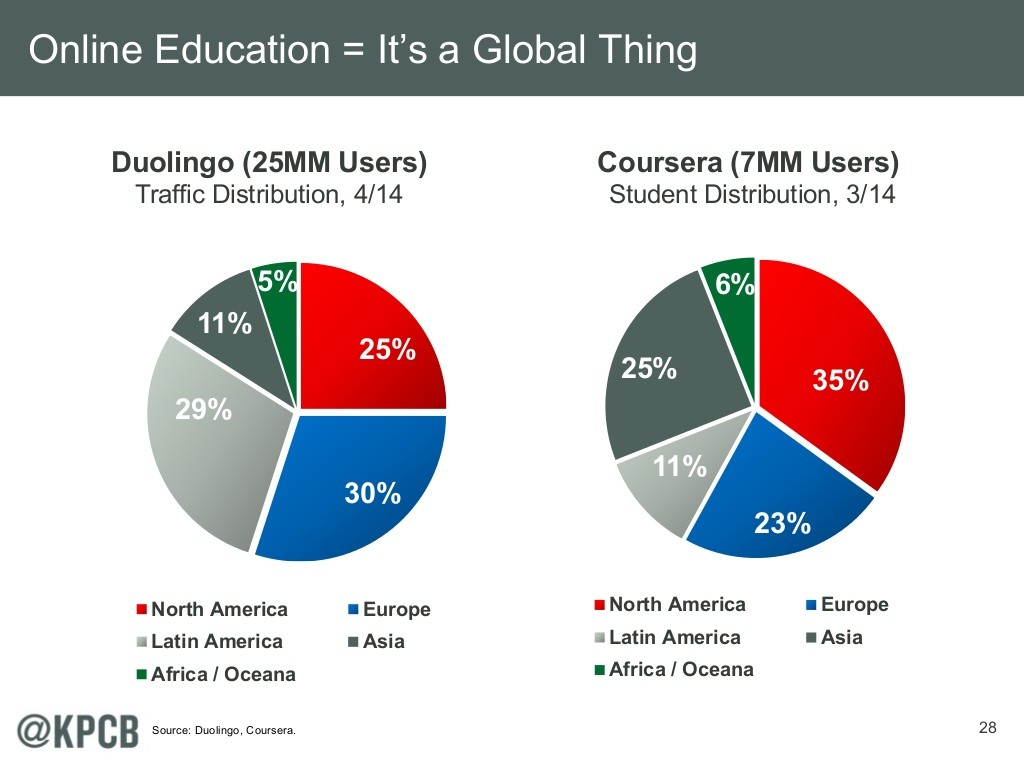
Image Source: https://www.kleinerperkins.com/perspectives/2014-internet-trends, slide 28
Internet service providers, cell phone companies, companies, and governments should provide free Wi-Fi zones or areas where people can connect to and browse the Internet for free. Service providers should offer free days, weekends, or evenings to encourage Internet use. Governments should invest in providing or subsidizing the cost of fast internet access. Internet access must be available in all regions of the country. The investment in backbone connectivity will reap rewards for decades.
The theme of the 2017 UN International Literacy Day on Friday, 8th September, was ‘Literacy in a Digital World’. The Day highlighted the importance of digital literacy skills. Technology literacy is essential for growth and development in today’s highly connected society. Businesses and Governments should work towards providing free computer training at schools, universities, public libraries,s etc. All schools and colleges should be equipped with computer labs. Secondary schools and colleges should provide basic computer training to all students. This will help prepare students for competency and success in today’s technology-driven society.
Governments need to pay more attention to the adoption of Information and Communications Technology (ICT) skills and the computer literacy rate. The UN has identified this as an indicator worth measuring. This will doubtless receive increasing attention in the coming years.
“Indicator 4.4.1, selected for Target 4.4 by the Inter-Agency and Expert Group on Sustainable Development Goal Indicators (IAEG-SDGs), focuses on the: “Proportion of youth and adults with information and communications technology (ICT) skills, by type of skill”. A second indicator has since been advanced: “Percentage of youth/adults who have achieved at least a minimum level of proficiency in digital literacy skills”. http://uis.unesco.org/en/blog/tracking-literacy-increasingly-digital-world-0
When people have poor skills, this severely limits their access to better-paying and more rewarding jobs.
“This also matters to the economy. Put simply, when people lack key skills, it becomes difficult to introduce productivity-enhancing technologies and new ways of working, which in turn stalls improvements in living standards.” https://www.weforum.org/agenda/2017/02/a-quarter-of-adults-can-t-use-a-computer/
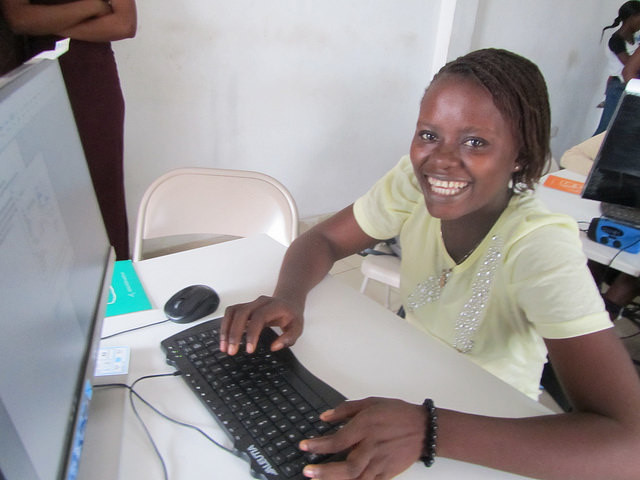
Image Source: https://developafrica.org/education-Africa
A business website serves at least four purposes (publicity/marketing), E-commerce (selling products online), service delivery, and information management. A website offers tremendous potential in helping businesses grow and reach new customers. With the growth and penetration of social media, more and more people are searching online for products and services. The absence or presence of an updated website could make a huge difference in the choice between competitors.
Governments and agencies need to encourage businesses to get their businesses online and develop a presence on social media. This process involves:
a) Explaining to businesses how e-commerce could help them grow their businesses
b) Providing training in setting up / managing e-commerce websites
c) Providing online portals where businesses can easily sign up for and create websites
Government agencies, ministries, and departments, in like manner, need to show themselves as being ready for the electronic age. Each agency must have an informative website with forms and resources provided online. Today, it is unfortunately common to see officials using personal Gmail and Yahoo email addresses on official government business. In other instances, I have seen official-sounding email addresses at Gmail.com. As Africa works towards presenting an image of being “open for business”, government officials need to actively consider using official-looking email addresses — provided by the ministry or agency.
Additionally, many colleges/universities do not have a professional website. Where a website exists, it frequently has frequently not been updated for many years. At many universities, professors are unreachable online. Universities must provide and require that faculty and staff use official email addresses.
The promotion of digital payments has been spearheaded by banks, competing with each other in rolling out features. Governments need to play a larger role in this sphere and put in place better controls and security. As nations move away from being primarily “cash-driven economies”, there is a definite need for a backbone framework that will help support accountability, trustworthiness, and security. Regulations need to be put in place to ensure the privacy of records and oversee the integrity and security of Bank systems.
The assurance that the government is safeguarding deposits and easy wireless access to deposited funds could be the triggers that finally help convince the diehard people who prefer to deal in cash to make the transition to electronic payments. As this happens, the percentage of transactions that are cash will gradually decrease. BBanksand governments could offer additional incentives for businesses to accept electronic payments.
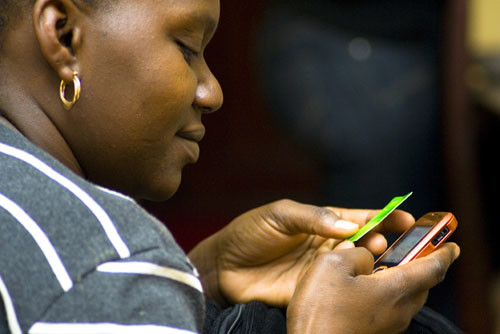
Image Source: https://pamojamedia.com/for-africa%E2%80%AD-mobile-technology-is-the-future/
The story of the launch and growth of M-PESA in Kenya is a great example of how Africans can innovate and revolutionize a system — in this case, mobile payments https://mag.n26.com/m-pesa-how-kenya-revolutionized-mobile-payments-56786bc09ef. Instead of only using the system to make and receive loan payments, Kenyans started using it to send and receive money to family, friends, and businesses. M-Pesa has changed the way people do business today by making payments easy and convenient. The Kenyan government continues to play a key supporting role, providing assurance.
“Kenya’s M-Pesa proves that when people are empowered, they will use digital tech to innovate on their own behalf.” — Bill Gates.
This could also include the development of a national digital profile database that will include financial lending history. This could be useful in the long run, showing creditworthiness when applying for a loan.
Today, online education is becoming increasingly important. Access to information 24/7/365 will play an increasing role in the future. Universities globally are focused on providing more and more classes … and even entire programs online. This wave of online access is likely to continue to increase as it makes learning available 24/7/365 to both transitional and non-traditional students.
Ensuring access to on-demand learning online should be a key goal of governments and universities. Universities and faculty must be encouraged to make their classes available online using course learning systems like Moodle. Colleges or departments should set goals and expectations for faculty to use online course learning systems. Training and support must be provided to faculty to develop online classes at all levels. Incentives should be provided to professors to develop and teach online classes. This will help increase enrollment and degree completion.
As colleges place more and more of their content online, professors in the diaspora could join the local faculty in teaching online courses. This will result in a more experienced faculty and diversification of the available course offerings.
A 2011 study (McKinsey Global Institute, 2011) established that a mature Internet “ecosystem” — where competition is fostered, innovation is encouraged, human capital and Internet infrastructures are developed, and Internet access is boosted — enables a country to secure the maximum possible benefit in raising living standards.
How do you see the internet affecting development in Africa?